

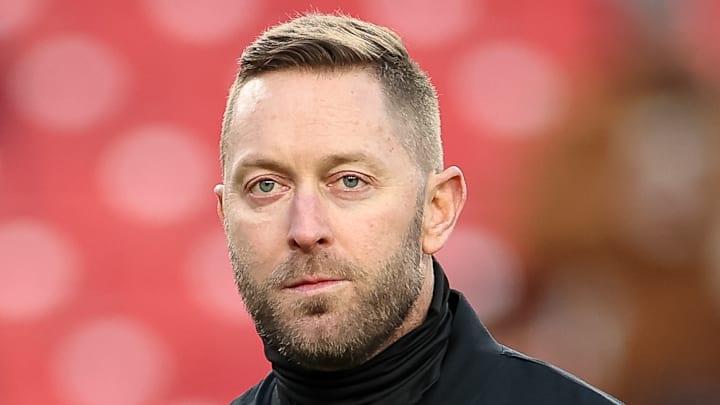
After a week that saw legendary figures like John Harbaugh part ways with their long-time franchises, it’s perhaps less shocking that the Washington Commanders have officially moved on from Kliff Kingsbury.
Despite his reputation as a quarterback whisperer — boasting a résumé that includes Patrick Mahomes, Kyler Murray, and Jayden Daniels —Kingsbury’s tenure in D.C. ended by hitting a very familiar wall.
While the team's Cinderella run to the NFC Championship game temporarily masked the flaws, the data from the last two seasons proves that the Kliff Cliff isn't just a narrative, it’s a statistical inevitability.
The mirage of Commanders' surge under Kliff Kingsbury
Kingsbury’s Air Raid offense is a gift for young quarterbacks early on. By utilizing quick reads, high-volume RPOs, and a spread field with limited receiver movement, he allows rookies to play fast.
In 2024, this approach gained widespread adoption. Over the first nine weeks, Washington looked like a juggernaut, averaging 29.2 points per game and propelling Daniels into the NFL MVP conversation with a 7-2 start.
Then, as it always does, the tape caught up.
Once NFL coordinators identified Kingsbury’s static tendencies, efficiency cratered. Excluding a Week 13 blowout of the Tennessee Titans, Washington’s offense plummeted from a top-three unit in Expected Points Added (EPA) to the middle of the pack during the second half of the year.
Kliff Kingsbury's pattern of one-dimensionality
The most damning evidence is that Kingsbury abandons the run game in the second half, and as the season progresses.
The 7-2 start in 2024 was built on a balanced 48-52 pass-to-run split. However, over the last three regular-season contests, that ratio shifted to a lopsided 60-40, putting additional pressure on Daniels.
This season, despite being fifth league-wide in yards per rush attempt, Kingsbury quickly went away from the rushing attack, especially on key second downs. In the Week 13 loss to the Denver Broncos, the Commanders entered the half with 13 pass attempts and 17 rushing attempts, with the opposition holding a slight lead.
Despite the close score, in the second half and overtime, Kingsbury ran 37 pass attempts compared to 16 rushes.
This same lack of balance is nothing new for the coach and was evident during Kingsbury's tenure as Arizona Cardinals head coach.
In 2021, the Cardinals started 7-0, leveraging a balanced attack, with a 51.51-48.49 pass-to-run ratio. This led to an NFL-leading 32.14 points per game.
After their bye week, the Cardinals became completely one-dimensional, with a 60 percent pass-play rate across their final seven games, including their playoff loss to the Los Angeles Rams. During that span, the team had an almost 11-point drop-off in points per game from their 7-0 run.
The wear and tear of static schemes
Kingbury's offenses not only cause pain on the scoreboard, but the pressure on the quarterback tends to boil over during his tenure. His system relies on mobility. By the end of the year, that can be taxing and injurious to his signal callers.
We saw Murray break down in Arizona, and we saw Daniels struggle with injuries this season. Rather than adapting his offense with pre-snap motions, Kingsbury stuck to his guns, with Washington ranking in the bottom five in motion percentage both last year and in 2025.
As Dan Quinn searches for a new offensive leader, the ghost of his own past looms large. His Atlanta Falcons teams were known for their balance, yet notoriously failed to run out the clock during the biggest Super Bowl collapse in history.
Now that he has parted ways with both his offensive and defensive coordinators after a disappointing 5-12 campaign in 2025, the pressure is on Quinn to deliver or risk a similar outcome.
 Add us as a preferred source on Google