

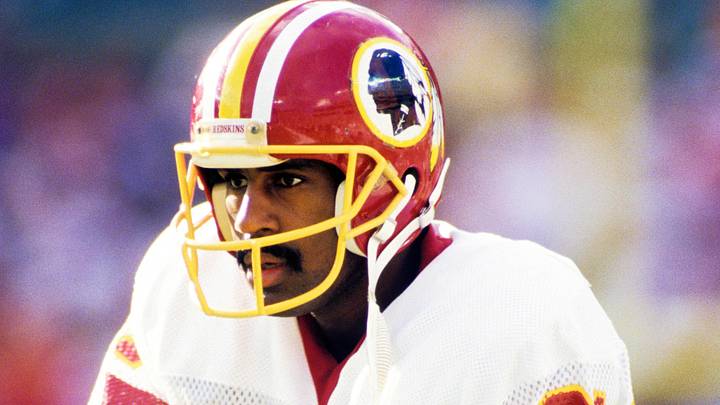
If you weren't a fan of the team now known as the Washington Commanders in the 1970s, it can be hard to understand the excitement that greeted Art Monk's arrival.
It wasn’t necessarily because Monk was a generational talent at wide receiver. Everyone knew he was very good at Syracuse, but few saw a future Pro Football Hall of Famer.
Monk’s arrival signaled more than the talent he brought to town.
Art Monk, the quiet assassin, began a culture change in Washington that led to championships
He was a symbol of rebirth.
Washington had not had a first-round draft pick in more than a decade. The last one was Jim Yazoo Smith, who lasted one year before suffering a career-ending neck injury. Before that, they spent their first-rounders on a failed running back and a fairly good kicker.
No first-round pick had made much of an impact in Washington since 1964, when Hall of Fame receiver Charley Taylor joined the club. That hints at the pressure of expectation that greeted Monk.
Bobby Beathard was Washington’s young general manager in 1980. He arrived in 1978 but had to scrounge around the back end of the draft for a few seasons before he could begin working his magic. The previous regime was led by George Allen, a coach whose motto was “the future is now.”
Allen hated rookies almost as much as he hated the Dallas Cowboys. He promptly traded away a decade’s worth of high-value draft picks to rebuild his team with veterans.
It worked early in the 1970s when Allen took his over-the-hill gang to their first Super Bowl. But the bill came due late in the decade when everyone got old all at once. It cost Allen’s successor, Jack Pardee, his job and opened the door for new coaches and new players galore.
Washington’s top receivers when Beathard came on board in 1978 were … anyone care to guess?
Danny Buggs — 36 catches for 575 receiving yards. John McDaniel was right behind him. They had very good yards-per-catch numbers, but overall, neither finished in the top 40 in catches or yards.
And lest you forget, there were only 28 teams in the entire league back then. The next year was more of the same, though Buggs’ 46 catches put him in the top 40. He was 40th.
Monk was supposed to fix that problem.
He was supposed to inject youth, energy, and excitement into an old, tired franchise. The amazing thing is that Monk — one of the quietest, least braggadocious wide receivers the league has ever seen — did just that.
Art Monk evolved into Washington's most prolific possession receiver ever
Monk caught 58 balls that first year for 797 yards. Both were rookie records for the club. He repeated those numbers in 1981, only upping his yards per catch and touchdown marks.
A strike-shortened 1982 season lowered his numbers, but he still led the club. But an injury forced Monk to miss the playoffs, so he had to watch his team win their first championship from the sidelines.
That disappointment stayed with him for a long time. But fortunately, he would make it back to the big game several times in his career.
On the field, Monk was the consummate pro.
He was a spectacularly good athlete, with the size and coordination to run any pattern and catch any pass. Monk had lined up in the backfield quite a bit in college and — much like previous franchise greats Bobby Mitchell and Taylor — he used his running back experience to great effect as a receiver.
The one thing missing from Monk’s athletic profile was Taylor’s blazing speed. He wasn't destined to be that kind of devastating downfield threat. So Monk developed a different type of game. He became one of the league’s best possession receivers.
From 1984 to 1991, Monk averaged more than three first-down catches per game. He was the first NFL player to crack the 100-catch season. A couple of receivers in the old AFL had accomplished it, but Monk’s 106 catches in 1984 broke their records.
He established a league record for consecutive games with a catch and retired with the most catches in league history.
His records have all been broken as the NFL designed its rules to encourage more passing, but Monk still ranks 25th in career catches. All 24 men ranked ahead of him began their careers under a more pass-friendly rulebook.
What is easy to overlook when citing Monk’s skill as a possession receiver is that he could have done more if required.
He may not have had a sprinter’s speed, but Monk was plenty fast. His YAC talent made him dangerous no matter where he caught the ball. In his second season, the three-time Pro Bowler averaged 16 yards per catch, and two years later, he posted 15.9.
That put him in the top 20 in the league ahead of downfield threats like Roy Green, Steve Largent, and Stanley Morgan.
Washington legend Art Monk was way ahead of his time
Monk’s role changed as Beathard assembled more and more talent. First, it was Virgil Seay. He would be followed by Charlie Brown, Gary Clark, and Ricky Sanders. They were all smaller, faster receivers with excellent downfield skills.
So Monk became the reliable guy over the middle. He ran the slant on third and five, took the hit from Harry Carson or Andre Waters, and got the first down.
He also became one of the best blocking wideouts the league has ever seen.
In a way, Monk was the harbinger of the new prolific passing offenses that were about to seize hold of the league.
He put up bigger, more consistent numbers than any wideout had to that point. Consider that two NFL first-team All-Decade receivers from the 1970s — Lynn Swann and Drew Pearson — ended their careers with 825 combined catches. Monk finished with 940 by himself.
He may not have been as good a deep threat, but he was so consistent and reliable that he very nearly matched the total combined yardage of Swann and Pearson.
Five years after Monk joined the NFL, Jerry Rice arrived, and things would never be the same.
In a sense, Monk’s achievements would always exist in Rice’s shadow — but that is true of every receiver who ever played in the NFL.
Art Monk's quiet leadership truly set him apart
As great as his on-field accomplishments were, Monk was even more important off the field. He personified the type of professionalism Joe Gibbs and Beathard prized. He became the example to every young player who passed through. This is the way we work. For a man who barely spoke, he was a genuine leader on championship teams.
The famous story about Monk’s leadership came in 1990.
Washington had won two Super Bowls in the 1980s, but those days seemed to be slipping away. They missed the playoffs in 1988 and ’89, and after dropping a Thanksgiving Day game to Dallas, they stood at 6-5, in danger of missing the postseason for the third straight year.
Monk asked Gibbs if he could call a players-only meeting. He didn’t suddenly turn gung-ho. That was not his style. He simply told his teammates he intended to do everything he could to make sure they made it to the playoffs.
Nothing special about that — but coming from the man who never uttered more than two words at a time, it spoke volumes.
Washington went 4-1 over the final month and did make the playoffs. The following year, they won their third Super Bowl. Monk caught seven passes for 113 yards in that game as they steamrolled the Buffalo Bills.
The Washington teams under Gibbs had some huge personalities. John Riggins and Joe Theismann. Dexter Manley and Darrell Green. But the player who set the tone — the guy who established the work ethic and became one of the most popular players in franchise history despite barely uttering a word— was Art Monk.
He came to town carrying an entire fanbase’s hopes for a new era. Week in and week out, for 14 seasons in Washington, Monk delivered on the promise.
 Add us as a preferred source on Google