

The Bleacher Report released a ranking of the 99 greatest quarterbacks in NFL history, and as you might expect, it quickly became a hot topic for debate.
The Washington Commanders were well represented, although several of the final decisions were genuine head scratchers.
Since their birth as the Boston Braves in 1932, the franchise now known as the Commanders has used many quarterbacks. Sixteen of them are on the list. In a vacuum, that is an impressive total. Washington is one of 32 NFL teams, and yet 16 percentof the top 99 quarterbacks have worn their jersey.
Of course, numbers can lie. So who made the list?
Commanders were well-represented on The Bleacher Report's all-time quarterback ranking
Mark Rypien kicks things off at No. 97. That’s reasonable. It recognizes the tremendous success he had over a very brief run. Unfortunately, the MVP of Super Bowl XXVI simply didn’t produce at a high level long enough to deserve a higher ranking.
Then we begin a long stretch of signal-callers who were not primarily associated with Washington. Of the 16 players, four had virtually no impact in DC. Jeff Hostetler (no. 95), Frank Ryan (no. 83), Jim Hart (no. 69), and Rich Gannon (no. 50) each played a single season and made a combined seven starts.
Four others had a somewhat bigger impact but still started fewer than 20 games for Washington. That group includes Trent Green (no. 91), Doug Williams (no. 84), Alex Smith (76), and Donovan McNabb (no. 42). With the possible exception of Williams, all are primarily associated with other teams.
That means half of Washington’s representation mostly came for a cup of coffee at the end of their careers. Apart from Williams, they didn’t make much of a mark.
In addition to Rypien, seven other ranked quarterbacks had more significant careers in Washington. But even there, half of them had a greater impact on other teams.
Norm Snead (no. 87) played seven seasons with the Philadelphia Eagles after beginning his career with three in Washington. Brad Johnson (no. 85) managed two productive seasons in D.C. but played seven years on the Minnesota Vikings and won a Super Bowl with the Tampa Bay Buccaneers.
Kirk Cousins (no. 71) made 88 starts for the Vikings compared to 57 for Washington. And Mark Brunnell (no. 61) served three seasons in D.C. after a great nine-year run for the Jacksonville Jaguars.
That’s 13 of Washington’s 16 entries on the list. You may have noticed none have ranked in the top 40 so far. Only Rypien can be legitimately considered a Washington player.
The three remaining quarterbacks are obvious to long-term fans of the club. Joe Theismann, Sonny Jurgensen, and Sammy Baugh.
Theismann finished at no. 46 on the list. His peak years under Joe Gibbs in the early 1980s would move him higher, but he got a late start and therefore doesn’t have quite the longevity needed to move up.
Jurgensen is No. 38. He had almost no postseason success, but he did lead the league in passing five times and has three first- or second-team All-Pro selections to his name. I would certainly place him ahead of Joe Namath, who comes in at no. 33, and perhaps a few others, but I can’t get too worked up.
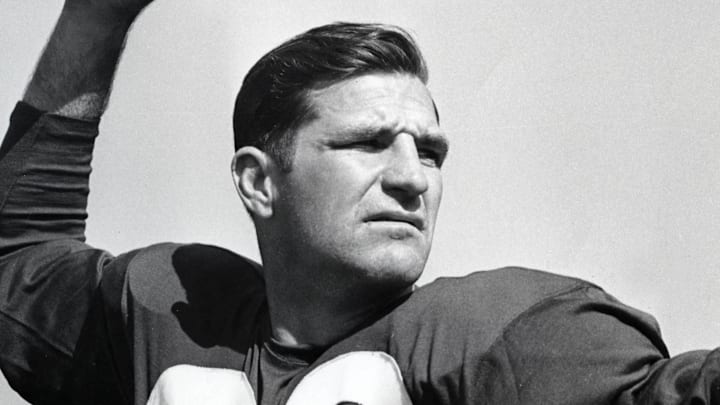
Baugh coming in at No. 26 for the man who invented downfield passing seems extremely low. He played 16 seasons, led his team to the postseason five times, and won two championships.
The franchise legend also led the league in passing four times, was selected to the first-team All-Pro four times, and to the second-team All-Pro four other times. Guess how many quarterbacks in the history of the league have more first or second-team All-Pro honors than Baugh.
The answer is four. Peyton Manning, Otto Graham, Johnny Unitas, and Sid Luckman.
A couple of the quarterbacks rated ahead of him actually won the Sammy Baugh Trophy for college quarterback play.
Baugh comes in two spots behind Eli Manning. He was never an All-Pro, either first- or second-team, and had just one lonely season in his 16-year career when he placed in the top 10 in overall quarterback rating.
Here’s the most maddening part. To compile their list, BR had its staff assign each quarterback a ranking from 1 to 99. They then arrived at a composite ranking. Baugh’s highest ranking was number seven. His lowest was number 96.
Somebody on that panel of experts looked at all the quarterbacks in NFL history and decided that Baugh was the 96th best. That spread, from 7 to 96, is far and away the widest on the list.
The lowest ranking for Jeff Garcia (no. 74 overall) was 94. That means somebody who was given a vote thinks Garcia is a better all-time quarterback than Baugh.
That is truly mind-boggling.
 Add us as a preferred source on Google