

The NFC East accomplished an ignominious feat in Week 5. None of its teams won a game.
That is by no means unheard of. But the Washington Commanders, Dallas Cowboys, Philadelphia Eagles, and New York Giants did it under the most difficult of circumstances.
First, none of the four had a bye, so each had a chance to win. Second, two of the teams played each other.
All Commanders fans know which those teams were and how that game ended.
Dan Quinn and Nick Sirianni employed diametrically opposed endgame strategies — and they both failed
In a strange way, the odd finish of the Eagles’ loss to the Jacksonville Jaguars may have affected the bizarre ending in Washington.
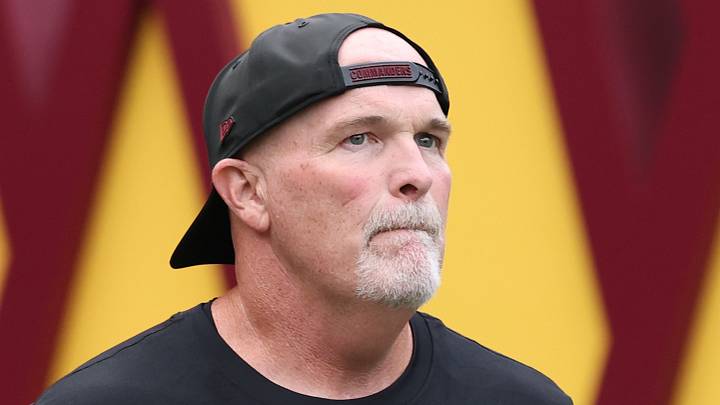
I’m not suggesting that head coach Dan Quinn was thinking of that Philadelphia game when he presided over the disastrous final seconds against the Giants. The two situations were related, but they were not identical.
Still, it is interesting to note that as Washington and New York were kicking off at Northwest Stadium, about 3,600 miles away in England, Eagles head coach Nick Sirianni was accepting the blame for bungling the end of his own game, making almost the exact opposite mistake from the one that Quinn and his Commanders would make several hours later.
Here are the similarities between the two games. With just a few seconds left on the clock, both the Commanders and Eagles were in position to kick a field goal.
Now, here are the differences.
Washington and the Giants were in overtime. The Eagles and Jaguars were finishing regulation. The Commanders and Giants were tied, while the Eagles trailed the Jaguars by two points.
Commanders' final sequence reasoning was fine, but the execution was abysmal
The Eagles had a timeout remaining. The Commanders did not.
Because the Eagles were still in regulation, the game would continue regardless of the outcome of their field goal attempt, as long as time remained on the clock. In Washington’s case, a successful kick would have immediately ended the game in a victory. The game could continue only if the Commanders missed the kick and time remained on the clock.
Sirianni’s mistake was not winding the clock down far enough so that no time would remain after the field goal attempt. It should have been the final play. A miss and Philly loses. But a successful kick should have meant an Eagles win.
By leaving eight seconds on the clock, Sirianni gave the Jaguars enough time for a big kickoff return and a long field, snatching defeat from the jaws of victory. The coach admitted as much after the game.
With a timeout in hand, he could have run the clock down to just a second or two, called his final timeout, and then sent his kicker out for the win.
But the bottom line — from a time management point of view — is that he could not leave any time on the clock after the kick.
Quinn would have been thinking the same thing.
The fact that a successful field goal would have ended the game regardless of the clock may affect the cost-benefit analysis, but it doesn’t change the underlying principle.
It was a wet field and a rookie kicker. There is no guarantee Drew Stevens makes the kick. If he misses, Quinn doesn't want to give the ball back to the Giants at the 33 with time for another play and then a long field goal. Then you risk losing what should have been, at worst, a tie.
Commanders lacked the desired urgency, and this was a collective failure
Well, they got a tie, but not for any defensible reason.
I have no problem with Washington bleeding the clock. But the players on the field clearly had zero situational awareness, which kept them from executing that clock-bleeding.
For some bewildering reason, they were running an actual play. Not a spike or a throwaway.
The play offered no benefit beyond bleeding the clock. The players on the field, quarterback Jayden Daniels included, had no sense of urgency until it was far too late.
They either assumed they still had a timeout, though that seems unlikely based on their actions, or they simply had no clue about how much time was actually left in the game.
That seems even less likely.
This comes down to Quinn. For him, this is what the Swinging Gate was for Jim Zorn.
Daniels and offensive coordinator David Blough may share accountability for the fiasco, but Quinn owns this. I don't fault his thought process, especially given what we all saw a few hours earlier in Philadelphia. Making the field goal attempt the final play of the game was the right strategy.
But that’s not what happened.
Daniels’ meaningless, time-wasting scramble was the last play of the game. Quinn, Bough, the signal-caller, and the rest of the offense and coaching staff collectively failed miserably when the game was on the line.
Fireable? That’s a little dramatic to me. But they absolutely deserve to be questioned and critiqued for conspiring to make a play that every fan watching could see was a terrible mistake. And the club will be rightly scrutinized on how they improve end-game decision-making and how well they respond after this travesty.
It is entirely possible that Quinn knew how that Eagles game ended and that the basic idea of it was in his head on Sunday.
If that is true, in a weird, small way, even though they were 3,600 miles away and suffering their own soul-crushing defeat, the Eagles may have contributed to Washington’s failure to improve to 2-3, and the NFC East’s embarrassing Week 5 in which none of the four teams won a game.
 Add us as a preferred source on Google