

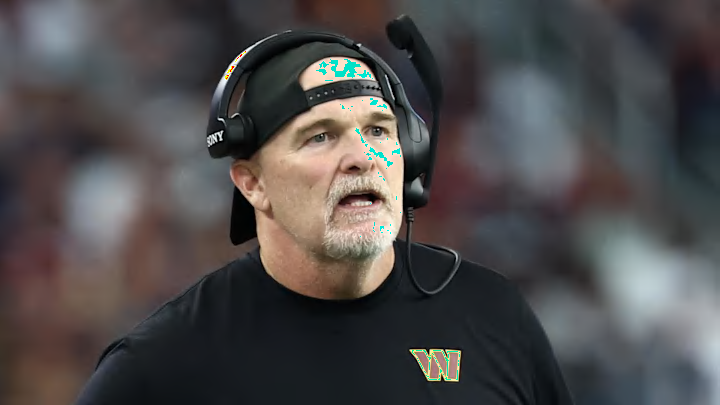
Four weeks ago, the Washington Commanders’ game against the Dallas Cowboys in Week 7 began shaping up as a tough test for Dan Quinn and his squad. Going into AT&T Stadium on short rest is testing enough. Gradually, other dominoes started to fall.
Dallas’ offense has been among the best in the league, even without star wide receiver CeeDee Lamb and KaVontae Turpin. Both were returning to the lineup. It was a dangerous situation for Washington because Joe Whitt Jr.’s defense has been prone to giving up big plays. Against Dallas, it seemed likely that they would be without their best defensive lineman, Dorance Armstrong Jr.
Jayden Daniels would be playing without his top three wide receivers, which made the odds against winning a shootout pretty steep. But there did appear to be one matchup that might favor the Commanders. One strategy to keep them in the game and perhaps allow for a divisional win on the road.
Through the first six weeks of the season, the Cowboys’ defense had been bad. Very bad. Dead last in yards allowed. Second to last in points allowed. Third to last in yards per play. You get the picture. Rushing yards, turnovers forced, penalties, sacks – in the bottom quarter of the league in almost every primary defensive statistic.
Commanders offensive line could take advantage of a favorable matchup against the Cowboys
The Commanders can run the ball. With rookie phenom Jacory Croskey-Merritt, several hard-running back-ups, and Daniels scrambling and executing read-options, Washington entered Week 7 with the league’s top rushing offense. And they finally had some good news on the injury front with the return of Sam Cosmi.
The recipe for victory seemed obvious. Run the ball. Dominate the line of scrimmage. Take advantage of Dallas' weak defensive front by controlling the clock and keeping their offense off the field. On paper, it made perfect sense.
Unfortunately, it was the Cowboys' front seven that controlled most of the game while Washington's offensive line struggled. The Commanders didn’t lose to Dallas because of the offensive line. A defense that gave up too many chunk plays was a bigger culprit. So were the penalties and turnovers. Daniels played poorly for his second contest in a row. His receivers were rarely able to make plays and had several key drops.
All those factors may have played a bigger role in Washington's loss. Still, the line play was very discouraging. That was the matchup that should have been the Commanders’ greatest strength, and it was not.
In the first half, the offensive line wasn’t too bad. The Commanders’ problems came more from Daniels' inaccurate throws and several drops. But there were signs of trouble to come.
Cosmi, understandably rusty after his long layoff, had a false start penalty that prevented a potential fourth-down conversion on the opening drive. Despite a few decent Croskey-Merritt runs early, as the game went on, Dallas' front seemed to grow more confident, and the Commanders' line was unable to get much push on running plays.
In short order, the Cowboys grew increasingly convinced that the Commanders’ backup receivers did not pose a serious threat. They played man coverage and crowded the box. Washington had no answer.
When they did pick up blitzing Cowboys, it seemed as if Daniels couldn’t make an accurate throw, or his receiver couldn’t make a catch. Still, despite some miscues and generally mediocre performance, the Commanders remained in the game through the first half.
The first 10 minutes of the second half were a nightmare. With Dallas getting more comfortable, Washington’s line broke down in a variety of ways. Penalties, miscommunication, and simple underperformance doomed the team. There were missed assignments galore.
It culminated with disaster on the final plays of each of the Commanders' first two second-half drives. On the first play, Washington’s three interior linemen combined to block two defenders while allowing blitzing linebacker Shemar James a clean shot up the middle on Daniels. It resulted in a fumble and, much more importantly, an apparent hamstring injury that knocked him from the game.
The game was essentially over at that point. If there were any doubts, they were erased at the end of the next series. A breakdown between center Tyler Biadasz and left guard Chris Paul allowed another free rusher to harass backup Marcus Mariota into a desperate throw that resulted in a pick-six.
Individually, none of Washington’s front seven distinguished themselves. Left tackle Laremy Tunsil was probably the best, but even he was on shaky ground. Cosmi looked like a man who hadn’t played in a long time. He rarely got a good push on running plays and seldom pulled on perimeter runs.
His communication with right tackle Josh Conerly seemed off the entire game. The rookie had his worst game since his Week 2 indoctrination against Micah Parsons and Rashan Gary. He was flagged for three penalties.
Biadasz and Paul had similar problems. Both missed multiple blocks against a defensive front that had been routinely dominated in previous games. And tight ends John Bates and Ben Sinnott rarely provided much help either.
All in all, it was simply an underwhelming performance by a unit that needed to come up big. Hopefully, some offensive weapons will return soon, and Cosmi will play his way into better form. Hopefully, Conerly will rebound, and the line play will find its cohesiveness. If not, things could be horrid next week.
Playing in the notoriously loud Arrowhead Stadium against a Kansas City Chiefs team that has allowed a total of 17 points and fewer than 400 total yards in the last two weeks is another enormous challenge. Without much better offensive line play, the Commanders will have little chance of keeping up.
 Add us as a preferred source on Google