

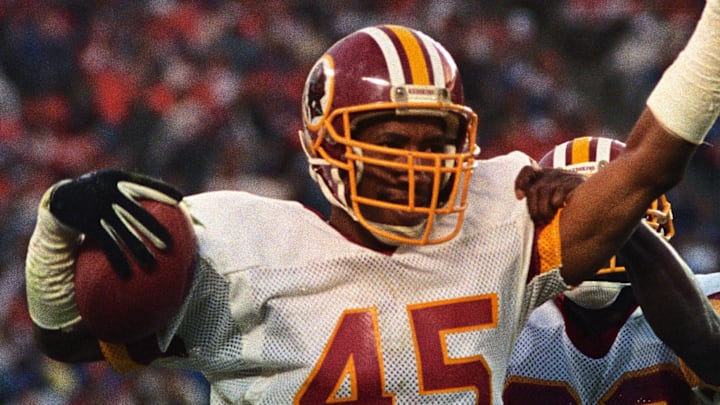
When he was a member of the 1987 champion Washington football team, Barry Wilburn was overshadowed by the other man playing cornerback. It was Darrell Green, arguably the most beloved franchise player over the last 50 years.
Last Thursday, when Wilburn tragically died in a house fire at the age of 62, he was overshadowed once again. It was the same day Washington lost the legendary Sonny Jurgensen, perhaps the most beloved player to generations of fans who began rooting for the club in the decades before Green’s arrival.
Wilburn did not have a career to match those two Pro Football Hall of Famers. But for a brief moment at the heyday of the franchise’s greatest success, he was a major part of everything that once went right in D.C. His time in town was brief, but memorable.
Barry Wilburn led the NFL in interceptions in a magical Super Bowl season
Bobby Beathard chose Wilburn in the eighth round of the 1985 draft. He took three other defensive backs, but higher selections like Tory Nixon and Raphel Cherry left little mark on the club.
It was Wilburn, 10th-round pick Terry Orr, and 11th-rounder Raleigh McKenzie who would play key roles in Washington’s second Super Bowl victory a few years later.
After serving as a backup for a couple of seasons, the Ole Miss alum took over for Vernon Dean in 1987, playing opposite Green. There was a players' strike that season, so members of the regular roster only played in 12 games.
Even so, Wilburn recorded a league-leading nine interceptions. In the final regular season game against the Minnesota Vikings, he picked off a Wade Wilson pass and returned it 100 yards for a touchdown. He is one of 42 players in league history to return an interception for at least 100 yards.
He kept up his ball-hawking through the playoffs, grabbing three more picks in three games.
In Super Bowl XXII, it appeared as though Wilburn’s magical run was coming to an end. On the Denver Broncos’ first play from scrimmage, John Elway hit Ricky Nattiel for a 56-yard touchdown. The rookie wide receiver ran right past him on the play. The television announcer said that Washington’s cornerback had been beaten in man-to-man coverage.
After the game — a dominant victory over the Broncos — multiple players confirmed that Washington was in zone coverage on the play. Miscommunication between Wilburn and free safety Todd Bowles led to the breakdown.
In the end, it wouldn’t matter. Wilburn would redeem himself with two more interceptions later in the game. The first came late in the second quarter, when Washington was in the process of producing the greatest single quarter in Super Bowl history. The next came a couple of drives later, at the beginning of the second half, and it essentially ended any hope of a Denver comeback.
Wilburn had four more interceptions in 1988, but personal demons were catching up with him. He was only 25, but it would be the last year he would have a major role for an NFL team. Drug problems put an abrupt end to his NFL career the following year.
He was out of football for several years, then bounced between the NFL and the CFL throughout the 1990s.
Wilburn was a tall, lanky cornerback who used his length to great advantage. He reminded fans at the time of Joe Lavender, another tall corner who had been on Washington’s first Super Bowl winner in 1982. He came from a family of world-class athletes. The legendary track star Wilma Rudolph was his godmother.
Cocaine derailed his career just as he was ascending in the NFL. There were some dark times in the years that followed his career as a pro athlete. But by all accounts, Wilburn was in a good place of late.
In an interview a few days after his death, his mother Margaret Matthews Wilburn — herself an Olympic bronze medalist — said, “He brought so much joy to Memphis, little ole Barry Wilburn.”
Back in 1987, he brought a lot of joy to Washington football fans as well.
 Add us as a preferred source on Google