

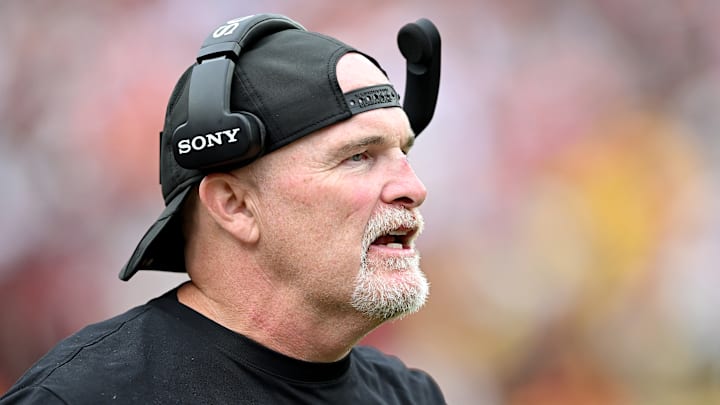
There was a play midway through the fourth quarter of the Washington Commanders’ frustrating loss to the Chicago Bears that will not show up on the stat sheet. However, it was representative of an increasing problem for Dan Quinn’s team.
Washington was clinging to a two-point lead when Tress Way pinned the Bears deep with one of his typically efficient punts.
Beginning a drive from their own nine-yard line, Caleb Williams tossed a short pass to Cole Kmet in the right flat. Commanders nickel corner Mike Sainristil had coverage on the play. He closed quickly and hit the tight end high. Initial contact came about three yards downfield.
Kmet then proceeded to drag the Commanders’ corner another eight yards until Sainristil finally forced him out of bounds at the 20-yard line.
You can feel for Sainristil in this situation. Kmet is more than a half foot taller and outweighs him by a good 75 pounds. It was a physical mismatch. In hindsight, the choice to hit the tight end around his shoulders seems ill-conceived, but it was going to be a challenging play for Washington’s second-year defensive back regardless.
Commanders secondary keeps getting exposed by their lack of size
Due to a penalty, the gain was nullified, and Washington forced a punt on the series. Even so, the play should not be overlooked, as it highlights an issue that Quinn and Joe Whitt Jr. must address.
To put it simply, the Commanders’ interior defensive backs are seriously undersized.
Being a bit undersized is not a deal breaker for a defensive back. There are plenty of smaller safeties and corners who have punched well above their weight throughout NFL history.
Bob Sanders was a dynamo at safety despite standing 5-foot-8 and barely cracking 200 pounds. Smaller slot corners like Mike Hilton and Kenny Moore have not let their size prevent them from performing at consistently high levels. Sainristil is cut from the same cloth. Though listed at 5-foot-10 and 182 pounds, he is ultra-tough and throws himself into much larger players.
But so far this season, he has not gotten the required results. Through five games, he had four missed tackles compared to seven all of last year. His missed tackle rate has risen from 7.0 to 13.5. And that doesn’t even include a play like the one on Kmet.
Even if it had stood, the cornerback would not have been credited with a missed tackle because he eventually did force Kmet out of bounds. It was simply a poor tackle. Not a missed one.
Sainristil is far from alone. Frankie Luvu is missing tackles this season at an alarming rate. Jeremy Reaves, who has taken over for Will Harris at strong safety, has already missed five tackles. And his fellow safety Quan Martin had the biggest miss of the Bears’ game when he failed to stop D’Andre Swift on his 55-yard catch and run that gave the teetering Bears new life in the fourth quarter.
It is painful to watch Martin, Reaves, and Sainristil miss tackles or otherwise get pushed around by bigger players without acknowledging one obvious fact. The Commanders’ two perimeter corners — Marshon Lattimore and Trey Amos — are textbook-size players, right around six-foot tall and 190 pounds. But there are three interior defensive backs — the two safeties and the slot corner — all decidedly undersized.
None of them weighs over 200 pounds. I can’t say this for sure, but I strongly suspect you could not say that about any other team in the NFL. I do know that in the NFC East, all of Washington’s rivals have bigger safeties and bigger or comparably-sized slot corners.
The blame does not fall entirely on Sainristil, Martin, and Reaves. Or on the scouts and coaches who assembled them. Reaves is a backup, filling in for the bigger Will Harris. And tackling, like all components of a defense, is highly collaborative.
Luvu’s struggles are partly of his own doing and partly due to the loss of Deatrich Wise Jr., Washington’s best run-stopping defensive end. Against the Bears, the Commanders were already playing without another excellent run-stopper in Eddie Goldman. When Dorance Armstrong Jr. was limited during the game, it left Whitt’s defense without any above-average run defenders on the edge. Chicago took full advantage, annihilating the left side seemingly at will.
If the big guys up front aren’t tying up blockers, it is tough for the more petite guys in the back to make aggressive tackles.
That helps explain why Washington’s run defense struggled against the Bears. If and when Goldman and Armstrong are at full strength and Luvu regains his 2024 form, that problem should diminish.
But the more persistent issue comes when these undersized interior defensive backs need to stop opposing receivers. Zone coverage schemes cannot work without sure tacklers. That is the point of a zone. A receiver might find a soft spot, but he should be closed down immediately for a short gain.
Winning the NFC East means shutting down big pass catchers like George Pickens, CeeDee Lamb, and Jake Ferguson of the Cowboys and the physically dominant Eagles’ targets A.J. Brown and Dallas Goedert. Washington’s safeties and slot corners need to play bigger than their listed heights and weights if they expect to win those games.
 Add us as a preferred source on Google