

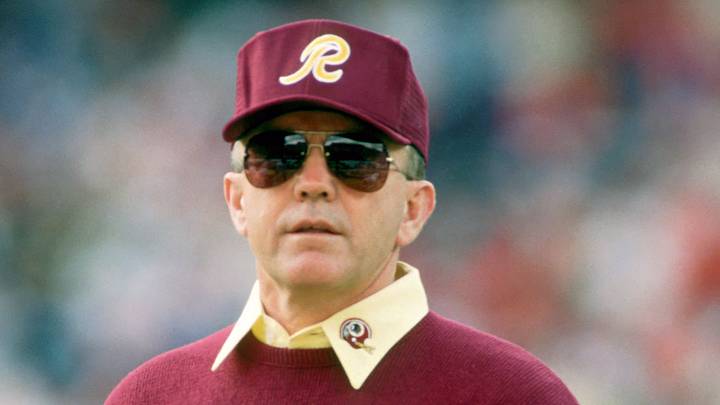
The team now known as the Washington Commanders has won five NFL championships. They have advanced to the NFL Championship game and lost six other times. They first made it that far before they even came to Washington.
Each of the first three men who owned the club — George Preston Marshall, Edward Bennett Williams, and Jack Kent Cooke — had at least one appearance in the big game. The last time came 35 years ago.
The franchise has been on a rollercoaster throughout its history.
The early Marshall years, with Sammy Baugh at quarterback, produced two titles. The Cooke era, led by coach Joe Gibbs, resulted in three Lombardi Trophies. But the second phase of Marshall’s tenure and the entirety of Daniel Snyder’s disastrous ownership were barren indeed.
Which was the best Washington team that did not make it to the championship game? The club that probably should have won the title but simply did not have destiny on its side? Well, there are several contenders.
You may note a little sleight of hand there. I switched from “championship game” to “Super Bowl.” Theoretically, that would exclude the first 40+ seasons in franchise history since the Super Bowl didn’t exist until the mid-1960s.
No matter. It doesn’t change the final verdict. But it does permit a brief aside in the honorable mentions.
- Honorable mentions
- 1939 – 8-2-1, second place in the Eastern Division
- 1973 – 10-4, second place in the NFC East
- 1974 – 10-4, first-place tie in the NFC East
- The greatest Washington team to miss out on the Super Bowl
Honorable mentions
1939 – 8-2-1, second place in the Eastern Division
There was no Super Bowl in 1939, but there was an NFL Championship game played between the first-place teams from the Eastern and Western divisions.
That year, the Green Bay Packers beat the New York Giants for the title. But many observers thought it should have been Washington playing Arnie Herber, Don Hutson, and the rest of the formidable Packer squad.
Washington lost a controversial regular season finale to the Giants, 9-7, when a last-minute field goal was ruled no good. Many in attendance — fans and players alike — thought the referee made the wrong call and that Washington really won 10-9.
The 1939 club had the third-widest point differential of any team in franchise history. Only a couple of Joe Gibbs squads, which played more games in a season, surpassed them.
The 94 total points allowed (in 11 games) is the fewest in franchise history. The defense, with bruisers like Ernie Pinckert, Wilbur Moore, and Wee Willie Wilkin, may have been the best the franchise ever fielded. And the offense, behind Sammy Baugh and Frank Filchock, held up their end of the bargain.
They may not have beaten the powerhouse Packers in the championship game, but they should have had the chance.
1973 – 10-4, second place in the NFC East
One year after reaching their first Super Bowl, coach George Allen had his team primed to return. He added safety Kenny Houston and linebacker Dave Robinson to an already tough defense. The mercurial running back Duane Thomas arrived to join a backfield led by Billy Kilmer and Sonny Jurgensen, who shared quarterback duties.
Other dynamic offensive players included Larry Brown, Charley Taylor, Roy Jefferson and Jerry Smith. They even had one of their greatest kick returners in Herb Mul-Key.
But age was already showing, and in the playoffs, Allen's veterans couldn't hold off a second-half charge by the Minnesota Vikings, which kept them from reaching the conference finals.
1974 – 10-4, first-place tie in the NFC East
On paper, the 1974 team looked a lot like the 1973 version, but the clubs had a different flavor.
When 1974 began, it seemed as if the George Allen “future is now” philosophy had run its course. After dropping their second game to the St. Louis Cardinals, Allen’s men were just 4-3 and in danger of missing the playoffs. Then they went on a tear, winning six of their final seven games, outscoring their opponents 186-95 over that span.
Otherwise, it was indeed a very similar team, with a dominant defense anchored by Houston, Chris Hanburger, and Diron Talbert, and a dynamic passing attack with Billy and Sonny again sharing the controls.
And once again, they came up short in the divisional round, this time falling on the road to the Los Angeles Rams.
The greatest Washington team to miss out on the Super Bowl
1984 – 11-5, first place in the NFC East
Two years after their first Super Bowl victory, and one year after their humiliation at the hands of the Raiders in Super Bowl XVIII, Joe Gibbs did arguably his best coaching job.
He revived a playoff-weary squad that was 5-4 after nine weeks. Once again, they finished on a tear, winning six of their final seven games.
What made this accomplishment so impressive was how much talent spent a major chunk of the season on the injured list.
Joe Washington and Charley Brown were explosive playmakers who missed half the season. John Riggins seemed to be in and out of traction every week. Up front, Jeff Bostic and George Starke missed major time.
Still, riding Riggins and a record-breaking performance from Art Monk, the offense scored 426 points, the sixth-most in franchise history. They again posted a point differential over 100.
On defense, Charles Mann, in his second year, came into his own, completing a devastating defensive front along with Dexter Manley, Darryl Grant, and All-Pro Dave Butz. Darrell Green, in his first of seven Pro Bowl seasons, anchored the secondary and, with Vernon Dean, formed one of the league's best cornerback duos.
In hindsight, 1984 marked a changing of the guard.
Joe Theismann and Riggins were near the end of their illustrious careers. The team that knocked them out of the playoffs — the Chicago Bears —was on the rise.
They sacked Theismann seven times in the playoffs, offering a glimpse of what was to come the following season. But still, that 1984 Washington team had the heart and talent of a champion. If it didn’t, there’s no way many of those same players would have stormed back to a Super Bowl championship a few years later.
That kind of historical perspective lets us say this, even though I cannot make similar claims for the 2024 squad.
That team, built around quarterback Jayden Daniels' exceptional rookie season, scored the second-most points in franchise history and made it to the conference finals. But the severe drop-off of the last two years makes us question just how good that 2024 squad was.
Those questions don't really linger with Joe Gibbs teams from the mid-1980s. Washington was always going to be a contender. Things didn't work out for them in 1984, but it shouldn't detract from how good that version truly was.
 Add us as a preferred source on Google