

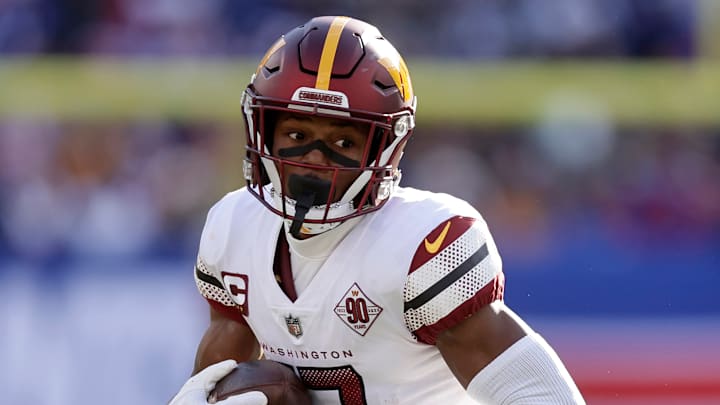
Terry McLaurin is holding out of Washington Commanders training camp on the reserve/did not report list. And he's not the first influential player in franchise history to go down this route.
Every day seems to bring a new story — some positive, some negative — about where contract negotiations stand. Hopefully, in the not-too-distant future, it will include an update announcing that a deal has finally been reached and Washington’s standout wide receiver is back at practice.
This holdout has had no real impact yet. Other than spilling hundreds of thousands of words throughout the cyberverse, McLaurin’s absence has not mattered.
He’s a veteran. He has a year of work with quarterback Jayden Daniels under his belt. If it weren’t for the distraction it has caused, you could almost see McLaurin’s absence in a positive light. Without him on the field, it should give the signal-caller more time to bond with other receivers looking to make a mark in 2025.
But that all assumes the player's representatives and Adam Peters find some middle ground soon. What if the unthinkable happens and McLaurin continues his holdout into the season? What if he sits out the entire year?
Seems unlikely, but not impossible. It has happened at least three times in the past 50 years in Washington. Star players were willing to sacrifice an entire season in search of a better contract. The results were never good, though the long-term outcome was not always bad.
Josh Harris is ostensibly Washington’s fifth majority owner — I’m not counting the board that ran the team between the death of Jack Kent Cooke and the final sale to Dan Snyder. The first owner, George Preston Marshall, was famous for his stinginess. Holdouts during his tenure were not uncommon.
But back in those days, holding out often meant simply retiring from the game and finding a real job. NFL salaries weren’t enough to keep players locked in. Some had greater earning potential outside the league.
Then, there were the brief periods during which rival leagues offered an alternative to players dissatisfied with their salaries. That happened most famously in the mid-1950s when the club lost several star players to the Canadian Football League. Quarterback Eddie LeBaron and defensive end Gene Brito didn’t hold out. They just signed with the CFL.
The owners who followed Marshall — Edward Bennett Williams, Cooke, and Snyder — each got to play the holdout game, though in Williams’ case, it was as team president under Cooke’s ownership.
Let’s take a quick look at three times when a star player in D.C. chose to sit out an entire season rather than play under a contract he deemed insufficient.
Three mammoth holdouts from Washington Commanders franchise history
John Riggins – 1980
John Riggins developed into one of the league's best running backs during five years with the New York Jets before coming to town. In a move that still defies logic, head coach George Allen paid him a boatload of money to join Washington and serve primarily as a blocking back.
The club had a good young runner in Mike Thomas. Allen and offensive coordinator Charlie Waller figured Riggins could block and get the ball on short-yardage downs. He ran for just 572 rushing yards in 1976 and then missed a good chunk of the following year.
Things changed in 1978. Allen was out as coach. New head man Jack Pardee brought in Joe Walton to open up the offense. One of the things he did was feed his big back. Riggins ran for better than 1,000 yards in both 1978 and 1979. And he wanted to be paid accordingly.
General manager Bobby Beathard was faced with a dilemma. Riggins was 30 years old. Running backs rarely stayed productive past that age. He was not inclined to pay top dollar. So both sides dug in. The player ended up sitting out the entire 1980 season.
He returned in 1981 with his famous “I’m bored, I’m broke, and I’m back” line. In hindsight, Riggins' holdout was devastating in the short term, likely costing Pardee his job. But it opened the door for the arrival of Joe Gibbs.
The coach and player were able to work out their differences and launch a dynasty that lasted for the next decade. Riggins was long gone by the time of Gibbs’ third Super Bowl win. But his holdout, in a strange way, led to the greatest period in Washington franchise history.
Sean Gilbert – 1997
The same cannot be said for Sean Gilbert, the talented defensive tackle who played just one season in D.C. His story is almost the exact opposite of Riggins’.
It begins the same. Gilbert was a star player for the Rams during his first four seasons, but Steve Ortmayer had concerns about his reliability. When he became available via trade, Washington’s Charlie Casserly, eager to rebuild a weak defense, leapt at the chance to acquire the rising star.
Gilbert played well in 1996. His sack total was nothing special, but he was a force in the middle of the line, especially against the run. Then, during the offseason, after he'd been ordained as a minister, the interior presence announced he had received a message from God saying he should be paid $5 million in his new contract.
Casserly wouldn’t go higher than $4 million. Washington franchise-tagged Gilbert, and he stuck to his guns, sitting out the entire 1997 season. He returned the following year with a team that met his demands — the Carolina Panthers.
Washington battled throughout the 1997 season. With Darrell Green, Cris Dishman, and Ken Harvey, their defensive back seven was quite good. But they struggled up front. Gilbert may have made the difference between the 8-7-1 record they finished with and a playoff berth.
Washington should have made out better than it did in the aftermath of the Gilbert fiasco. They got a lot of draft compensation from Carolina, which they were able to parlay into Champ Bailey, Lavar Arrington, and Chris Samuels, among others. But it was not to be. The franchise was about to enter an upper management black hole, which kicked off a quarter century of futility.
Trent Williams – 2019
One of the lowest points of that futility came when Washington blew up its relationship with the best player it drafted during the 21st century.
Trent Williams is a future first-ballot Pro Football Hall of Famer. He had made the Pro Bowl as Washington’s starting left tackle for seven straight seasons. But dysfunction in the front office led to acrimony that could not be repaired.
At issue was Williams’ health. He felt the Washington medical team had mishandled a potentially serious condition he developed on his scalp, and then the front office refused to pay him what he deserved.
Washington was routinely running off some of its best players at this point in Snyder's ownership. Fellow Pro Bowl lineman Brandon Scherff never held out, but he scampered out of town as soon as he could. Williams was so down on the franchise that even the arrival of Ron Rivera could not sway him. The club was forced to cut its losses and take a below-market offer from the San Francisco 49ers to recoup something from the debacle.
Williams went on to multiple first-team All-Pro seasons, while Washington has struggled to develop offensive line cohesion ever since. It finally appears they are accomplishing that task.
What has made McLaurin’s holdout so painful is that he was on those same teams with Williams. He dealt with the dysfunction both on and off the field and never faltered in his commitment to the club.
Like Riggins, he might be older than ideal for a max contract. But his character and leadership, along with his talent, have made him a vital part of the Commanders’ success.
McLaurin needs to get his due and be back in camp as Washington moves forward. Failing to secure his services is not likely to result in anything good.
More Commanders news and analysis
 Add us as a preferred source on Google