

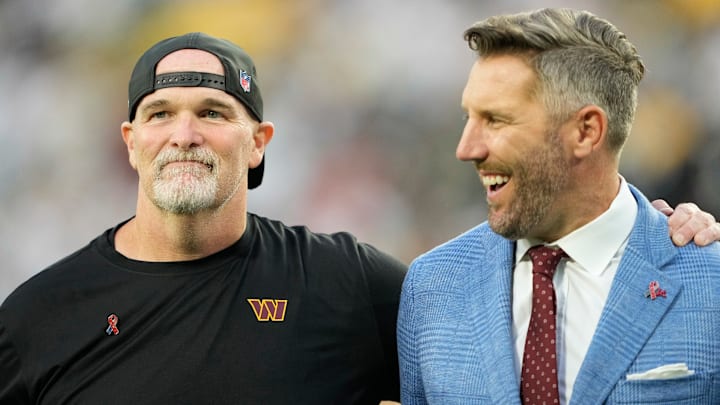
Washington Commanders general manager Adam Peters has said on multiple occasions that he believes in building rosters through the draft. That is not an earth-shattering statement.
Almost every general manager in the NFL would agree. The draft is where teams stock up on the young, inexpensive talent needed to field a complete roster in the salary cap era. Peters’ words may carry a little extra weight because he learned the ropes of roster-building with the San Francisco 49ers — a franchise that has manipulated the draft process as well as any team in the league.
There are plenty of metrics you can use to evaluate how a team does in the draft. One of the things the Niners have been known for under John Lynch is placing a very high value on compensatory picks. They are not afraid to let valuable free agents depart because they know it will result in an additional mid-round selection in the following year’s draft.
Commanders have to start building the right way under Adam Peters
That helps a team avoid costly bidding wars, which can drive up a free agent's price, freeing up salary cap space for a major acquisition like Christian McCaffrey or Trent Williams. But this strategy only works if a general manager has great trust in his draft system.
Consider what San Francisco did over a five-year period when Peters was there. Between 2017 and 2021, here’s who they selected in the fifth round of the draft: George Kittle, D.J. Reed, Dre Greenlaw, Colton McKivitz, and Deommodore Lenoir.
Those players account for 380 NFL starts. All are still in league.
As a comparison, the Commanders chose seven players in round five during that time frame: Jeremy Sprinkle, Tim Settle, Cole Holcomb, Ross Pierschbacher, Keith Ismael, Khaleke Hudson, and Darrick Forrest.
That’s 159 total NFL starts. Only two played a snap in 2025.
Clearly, the Commanders have needed a much better drafting strategy for quite some time.
The book remains open on Peters. The 2024 class looked good initially, but regressed in 2025. Last year's crop was smaller but featured several promising players, including a potential seventh-round star in Jacory Croskey-Merritt.
Heading into the 2026 free agency/draft window, Peters has a ton of money to spend and a modest collection of draft picks. He gave up his second and fourth round picks for Laremy Tunsil and got an extra sixth rounder for Brian Robinson Jr. That’s six picks in all, somewhat end-weighted.
Regardless of how he approaches free agency, Washington’s future will be determined by how well Peters uses those picks. The best front-office leaders do not allow themselves to be boxed in by need. The only position where that should ever happen is at quarterback, and Peters has that box checked.
He has to draft players who will still be in the league in five to seven years, in as many rounds as possible.
That requires great scouting, of course. It means looking beyond flashy NFL Scouting Combine numbers and seeking the most productive players possible in every round. But it also requires a mindset that says we will take great football players regardless of perceived need.
Did the Philadelphia Eagles need Jalen Carter in 2023? They had selected a player at the same position in the first round one year before. They still had Fletcher Cox and could have made a move to re-sign Javon Hargrave.
That same year, the Detroit Lions shocked the NFL by choosing Jahmyr Gibbs with the No. 12 pick. They already had D’Andre Swift and David Montgomery in the backfield and a desperate need to rebuild their defense.
When the Seattle Seahawks took cornerback Devon Witherspoon one pick ahead of Detroit, Brad Holmes traded back and chose Gibbs over several other cornerbacks and pass rushers who most analysts predicted he would take.
Howie Roseman and Holmes thought Carter and Gibbs were simply better players than anyone else at that point. The results are on the field and in the standings.
Peters can use his big salary cap surplus to patch holes. To build his best roster for 2026 and beyond, he has to acquire six players in the draft who can have the biggest impact, regardless of position.
 Add us as a preferred source on Google